
Carbon Loop #021

A newsletter by the CCUSNA dedicated to highlighting the Australian carbon capture, utilisation and storage industry.
What’s Holding Back AUCCUS ..
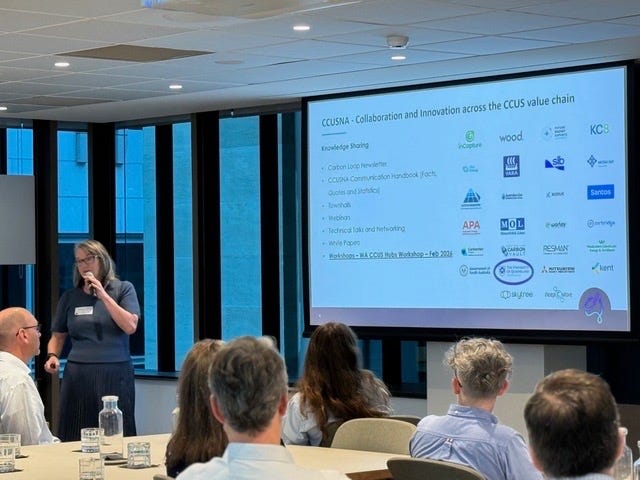
CCUSNA held its first east coast Technical Talk in Brisbane last week, co-hosted with UQ’s Gas and Energy Transition Research Centre. The framing question was direct: what is holding Australian CCUS back?
We were really pleased with the turnout and the engagement. Around thirty people attended and heard our Chair, Rosie Johnstone, present much of the research she completed in preparation for our CCUS Hubs Workshop, held in Perth earlier this year. The conversation stayed alive well past the formal close. The more interesting result: a Queensland CCUSNA Chapter is now firmly on the table, with a follow-up underway to bring in new members from the State that has (practically, if maybe not officially) banned CCUS as a carbon management technology. Turns out the best place to find people ready to do something is the state that’s been told it can’t be done.
Confused Europeans ..
Two signals came out of Europe in May, pulling in opposite directions.
First: the Commission approved Germany’s €5bn carbon contracts for difference scheme for heavy industry. This is the model Australian CCUS advocates have been pointing to for years as evidence that government-backed price certainty can mobilise industrial decarbonisation investment.
Second: DG CLIMA officials signalled the July ETS review will slow the carbon price trajectory, with free allowances for heavy industry likely extended well past current phase-out deadlines. The CfD compensates for a carbon price that is not rising fast enough. The ETS softening says the price was rising too steeply for heavy industry to absorb.
So which one is it?
Do we need to decarbonise urgently or is the burning slowdown more of a slow burn?
For CCS project economics, the net effect comes down to conditionality: if the extended free allocation comes with binding requirements to deploy capture (i.e. we will give you more time so long as you prove you are progressing a credible decarbonisation plan) that is a transitional measure that probably makes a lot of sense in the current chaos. Otherwise, it’s a delay. Let’s wait for the July review.
Read More --
Commission approves €5 billion German State aid scheme to support decarbonisation of industry
Commission holds a high-level stakeholder roundtable on the EU ETS review
(my AI proof-reader hated it, but I think “… is the burning slowdown more of a slow burn?” may be some of my best work!)
Hydrogen Headstart Signals Shift ..
The Australian Hydrogen Headstart Program has been one of this Federal Government’s flagship decarbonisation policies, and the HH Shortlist, released earlier this month, is worth a careful look.
Seven projects are listed: four are methanol plays, one is urea, one is alumina, and one is ammonia. Put another way, five of the seven projects shortlisted will require carbon feedstocks for success.
For methanol (four of the seven projects), renewable hydrogen is combined with a source of CO₂ to make CH₄O. In a full renewables pathway that carbon has to come from somewhere: direct air capture, biogenic sources, or captured industrial emissions.
And for Perdaman’s Helios Green-Urea Project in Karratha, the largest on the shortlist at a whopping 750MW of electrolysis, there is no steam reforming process generating CO₂ as a byproduct. So that CO₂ feedstock has to come from somewhere else, ideally from a newly established Pilbara carbon management industry.
The CCUS angle is in plain sight. Five of the seven shortlisted projects require both renewable hydrogen and a source of CO₂. Taken together, the shortlist validates CO₂ as an industrial input commodity to be strategically produced, not just a waste stream to be reluctantly managed. That is a quieter policy signal than what you get from the CCS storage debate, and it is good news for the CCUS case in Australia.
ARENA shortlists major projects to scale Australia’s renewable hydrogen industry
🌏 Global CCUS momentum
🇦🇺 Australia & Asia-Pacific
🏭 Moomba CCS passes two million tonne milestone — Santos’s Moomba CCS project in South Australia has sequestered two million tonnes of CO₂ in approximately 18 months of operation. A massively successful Australian industrial decarb project. Read more
🇪🇺 Europe
🧪 EU Fertilisers Action Plan confirms gradual path, ETS/CBAM as the main tools — The European Commission published its Fertilisers Action Plan on 19 May. The plan confirms ETS and CBAM as the core decarbonisation mechanisms for the sector, signals a more gradual phase-out of free allowances beyond 2034, and floats cleaner ammonia trade corridors with Africa and the Middle East as a longer-term objective. Read more
🏗️ The CCUS bottleneck has shifted from technology to market design — Ramboll’s Anna Pekala argues the technology questions have largely been answered (Brevik is capturing, Northern Lights is injecting) and the constraint has moved to market structure. Read more
📊 Key CCUS trends for 2026 — Syrie Crouch posts a graphic identifying key CCUS trends for 2026, framing the gap as coordination and integration rather than technology. Read more
🚢 BIMCO launches first standard contract for CO₂ shipping — The Baltic and International Maritime Council has introduced CO2TIME 2026, the first global standard contract for CO₂ shipping by sea. Read more
🌐 Global industry & tech
🏭 CCUS as industrial opportunity, not just a climate mechanism — CCSA’s Olivia Powis makes the case for CCUS as a revitaliser of industrial heartlands: job creation, infrastructure investment, regional economic anchoring. Read more
🔬 Automated screening accelerates DAC sorbent development — Decarbonisation Technology covers an automated CO₂ capture screening device for sorbent optimisation, reducing the material science bottleneck in direct air capture. Read more
📡 Chemical tracers: verifying that captured CO₂ stays underground — Tracerco’s Heinz Weidmann on using chemical tracer technologies to deliver data-driven certainty about CO₂ storage integrity. Read more
Thanks for reading The Carbon Loop!
If you found this issue helpful, the best way to support the newsletter is by sharing it with friends or colleagues who might also be interested in the latest Australian CCUS insights.
Thanks again for subscribing!